
Edge in the News





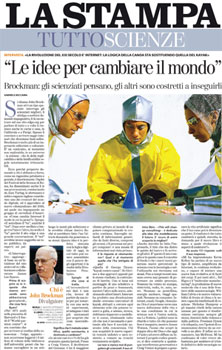
His name is John Brockman and he is a special type: he queries the best scientists, asks them to pose their most pressing questions, brings them together on his site edge.org to converse about everything and sometimes they also meet in the flesh, in California or in Paris. He often encourages them to write about their visionary ideas, which become best-selling books.
 Brockman is much more than a publishing and cultural impresario. He is unique, someone who is not replicable in the universe of science where replicability and falsifiability are notoriously non-negotiable rules.
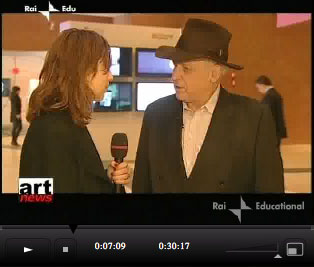
That is why his posing questions, like a petulant boy genius, to the world's greatest thinkers is disorienting. Guest of the Festival of Science in Rome, he has distributed his provocations there too, ranging from the subject of Alan Turing, the unfortunate and mythical English scientist who founded the digital world which led to his new Question of 2010, which has inspired a group of American thinkers: "How does the Internet change the way you think?" He explains: "I stress the "you" instead of "we". After oscillating between the two, I chose the "you" because Edge is a conversation. The "we" would have suggested a public voice instead, of experts on stage."
"The question," he adds, "is based on the idea of my friend and former collaborator James Lee Byars.
What did Byars do?
|
Photo of John Brockman |

"In 1971, he went to Harvard Square and there founded the "World Question Center". He was convinced that to reach the edge of knowledge, it was not in fact necessary to read 6 million volumes in the university library: he believed it was enough to collect the most sophisticated minds in one place and lock the door until they asked each other the questions they were asking themselves. This idea is in perfect harmony with the logic of today's digital environment, in which everything can be assembled with the power of algorithms: it is the reality of the Petabyte Revolution.
Explain what this is.
"The accumulation of data is such that instead of starting an argument and then testing it with a series of experiments, the data already stored may be investigated in order to discover what is hidden."
Does this mean that the scientific method, which is sacrosanct, is about to change?
"In any case, yes, there is someone who has already made this hypothesis. I think of Craig Venter, who is deciphering the Genome: he is the greatest advocate in the private sector of a continuing growth in computational power. He collects billions of pieces of genetic information from various sources, including the oceans and processes them using computers: it is a scale of data never dealt with before."
And the responses to the "Question"? What is currently the one that has intrigued the most?
"George Dyson's response: "kayak vs. canoe." It refers to two opposite approaches to achieving the same result, the construction of boats. The first entails the assembly of a skeleton from bits and pieces, and the latter involves carving out of whole trees. The Internet has produced a similar gap: we were manufacturers of kayaks, used to seeking any information that could keep us afloat, and now, instead, we must learn to shape the canoe, removing everything that is not necessary and bringing to light the hidden heart of knowledge. Whoever doesn't acquire the new skills will be forced to row his crudely carved tree trunks."
He never tires of prodding scientists: his latest book, This Will Change Everything, is dedicated to ideas that will shape the future. Are you sure to have discovered the best?
"In another career I acted as an impresario. I was the guy who ran the theatre, standing in the back, turning the lights on and off. This is my role and in this case, the basic concept I present is that new media creates new perceptions: science creates the technology to use and we recreate ourselves in its image. Until recently no one had ever thought of this process. It was unconscious. No one has voted on the printing press, electricity, radio, tv, cars, airplanes. Nobody voted for penicillin, nuclear energy, space travel. No one voted for computers, Internet, email, Google, cloning. Now we move towards a new definition of life and a condition in which science is not only news, but The News. Politicians can play catch up and and chase the developments. James Watson, the man who was co-discoverer of the double helix of DNA and who is currently only only one of two people to have posted his genetic code on the Internet, is said to oppose any interference. The other person, Craig Venter, is preparing to create artificial life: And even now, he can move a drop of genetic material from one dish to another and...your dog can become a cat. The result is that everything will change and therefore, the question for the new book was: What game-changing scientific revolution do you expect to live to see?
You had 151 responses: reveal your favorite.
"Kevin Kelley impressed me: he spoke of a new type of mind, amplified by the Internet, evolving, and able to start a new phase of evolution outside of the body. And so many others... Ed Regis and "molecular manufacturing", about the production of new molecules as one of the frontiers of nanotechnology. William Calvin and our vulnerability to climate and our intellectual capacity to react. Nicholas Humphrey and rebellious impulses of human nature: as we transform ourselves, we nevertheless remain the same, distracted by violence and politics. Freeman Dyson and telepathy, with the possibility of direct communication from one brain to another. And finally, a novelist, Ian McEwan. He confessed to wanting to live long enough to witness the final triumph of solar technology.




Today’s idea: Filtering, not remembering, is the most important mental skill in the digital age, an essay says. But this discipline will prove no mean feat, since mental focus must take place amid the unlimited distractions of the Internet.
Internet | Edge, the high-minded ideas and tech site, has posed its annual question for 2010 — “How is the Internet changing the way you think?” — and gotten some interesting responses from a slew of smart people. They range from the technology analyst Nicholas Carr, who wonders if the Web made it impossible for us to read long pieces of writing; to Clay Shirky, social software guru, who sees the Web poised uncertainly between immature “Invisible High School” and more laudable “Invisible College.”
David Dalrymple, a researcher at the Massachusetts Institute of Technology,thinks human memory will no longer be the key repository of knowledge, and focus will supersede erudition. Quote:

Before the Internet, most professional occupations required a large body of knowledge, accumulated over years or even decades of experience. But now, anyone with good critical thinking skills and the ability to focus on the important information can retrieve it on demand from the Internet, rather than her own memory. On the other hand, those with wandering minds, who might once have been able to focus by isolating themselves with their work, now often cannot work without the Internet, which simultaneously furnishes a panoply of unrelated information — whether about their friends’ doings, celebrity news, limericks, or millions of other sources of distraction. The bottom line is that how well an employee can focus might now be more important than how knowledgeable he is. Knowledge was once an internal property of a person, and focus on the task at hand could be imposed externally, but with the Internet, knowledge can be supplied externally, but focus must be forced internally. [Edge via The Daily Dish]
More Recommended Reading:
- The Washington Post’s “Collapse” – Gabriel Sherman, The New Republic
- Who Killed the Iranian Nuclear Scientist? – Dieter Bednarz, Der Spiegel
- An Experimental Homeless Community in the New Jersey Woods – Alex Morris, New York
- Far From Being Luddites, the Amish Are “Anything But Anti-Technological” – Kevin Kelly, The Technium
- Pentagon Sees Risk in U.S. Geek Shortage – Katie Drummond, Wired
- The Death of Joe Average – Frédéric Filloux, Monday Note
- Despite iPods and Walkmen, Rates of Hearing Loss Dropping – Alexis Madrigal, Wired
- Origins of the Hitler One-Testicle Story – Tony Perrottet, The Smart Set






Today’s idea: Filtering, not remembering, is the most important mental skill in the digital age, an essay says.
But this discipline will prove no mean feat, since mental focus must take place amid the unlimited
distractions of the Internet.
Internet | Edge, the high-minded ideas and tech site, has posed its annual question for 2010 — "How is the Internet changing the way you think?" — and gotten some interesting responses from a slew of smart people. They range from the technology analyst Nicholas Carr, who wonders if the Web made it impossible for us to read long pieces of writing; to Clay Shirky, social software guru, who sees the Web poised uncertainly between immature "Invisible High School" and more laudable "Invisible College." David Dalrymple, a researcher at the Massachusetts Institute of Technology, thinks human memory will no longer be the key repository of knowledge, and focus will supersede erudition. Quote:
Before the Internet, most professional occupations required a large body of knowledge, accumulated over years or even decades of experience. But now, anyone with good critical thinking skills and the ability to focus on the important information can retrieve it on demand from the Internet, rather than her own memory. On the other hand, those with wandering minds, who might once have been able to focus by isolating themselves with their work, now often cannot work without the Internet, which simultaneously furnishes a panoply of unrelated information — whether about their friends’ doings, celebrity news, limericks, or millions of other sources of distraction. The bottom line is that how well an employee can focus might now be more important than how knowledgeable he is. Knowledge was once an internal property of a person, and focus on the task at hand could be imposed externally, but with the Internet, knowledge can be supplied externally, but focus must be forced internally.







In 2006, the artist and computer scientist Jaron Lanier published an incisive, groundbreaking and highly controversial essay about “digital Maoism” — about the downside of online collectivism, and the enshrinement by Web 2.0 enthusiasts of the “wisdom of the crowd.” In that manifesto Mr. Lanier argued that design (or ratification) by committee often does not result in the best product, and that the new collectivist ethos — embodied by everything from Wikipedia to“American Idol” to Google searches — diminishes the importance and uniqueness of the individual voice, and that the “hive mind” can easily lead to mob rule.

Jonathan Sprague
Jaron Lanier
YOU ARE NOT A GADGET
A Manifesto
By Jaron Lanier
209 pages. Alfred A. Knopf. $24.95.