CULTURE

TEN PRINCIPLES FOR A BLACK-SWAN-ROBUST WORLD

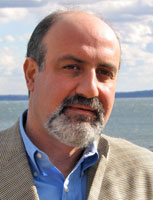
Nassim Nicholas Taleb
[4.15.08]

Let us move voluntarily into Capitalism 2.0 by helping what needs to be broken break on its own, converting debt into equity, marginalising the economics and business school establishments, shutting down the “Nobel” in economics, banning leveraged buyouts, putting bankers where they belong, clawing back the bonuses of those who got us here, and teaching people to navigate a world with fewer certainties.

Introduction

In his "Ten Principles for a Black Swan-robust world", Nassim Nicholas Taleb is on the ramparts assuming an activist role in urging us "to move voluntarily into Capitalism 2.0 by helping what needs to be broken break on its own, converting debt into equity, marginalising the economics and business school establishments, shutting down the 'Nobel' in economics, banning leveraged buyouts, putting bankers where they belong, clawing back the bonuses of those who got us here, and teaching people to navigate a world with fewer certainties."

"Then we will see an economic life closer to our biological environment: smaller companies, richer ecology, no leverage. A world in which entrepreneurs, not bankers, take the risks and companies are born and die every day without making the news."

The themes Taleb develops in this manifesto are an outgrowth of his 2008 Edge original essay "The Fourth Quadrant: A Map of the Limits of Statistics". (Aslo, see The Black Swan Technical Appendix.)

— John Brockman

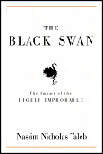
NASSIM NICHOLAS TALEB, essayist and former mathematical trader, is Distinguished Professor of Risk Engineering at New York University’s Polytechnic Institute. He is the author of Fooled by Randomness and the international bestseller The Black Swan.

Nassim Taleb's Edge Bio Page

ELIZA'S WORLD

Nicholas G. Carr
[4.3.08]

What is the compelling urgency of the machine that it can so intrude itself into the very stuff out of which man builds his world?

JOSEPH WEIZENBAUM

1923 – 2008

A former executive editor of the Harvard Business Review, NICHOLAS CARR writes regularly for the The Guardian as well as his blog, Rough Type. He is the author of the recently published The Big Switch: Rewiring the World, from Edison to Google, examines the rise of "cloud computing" and its implications for business, media and society.

Nicholas Carr's Edge Bio Page

THE REALITY CLUB: Jaron Lanier, Kevin Kelly

HYPERPOLITICS (AMERICAN STYLE)

Mark Pesce
[2.4.08]

The power redistributions of the 21st century have dealt representative democracies out. Representative democracies are a poor fit to the challenges ahead, and 'rebooting' them is not enough. The future looks nothing like democracy, because democracy, which sought to empower the individual, is being obsolesced by a social order which hyperempowers him.

Introduction

In his well-received talk at this year's Personal Democracy Forum (organized by Andrew Rasiej and Micah Sifry), "digital ethnologist" Mark Pesce makes the point that "we have a drive to connect and socialize: this drive has now been accelerated and amplified as comprehensively as the steam engine amplified human strength two hundred and fifty years ago. Just as the steam engine initiated the transformation of the natural landscape into man-made artifice, the 'hyperconnectivity' engendered by these new toys is transforming the human landscape of social relations. This time around, fifty thousand years of cultural development will collapse into about twenty.

In presenting his ideas on "the human network" Pesce references the work of archeologist Colin Renfrew, that "we may have had great hardware, but it took a long, long time for humans to develop software which made full use of it"; and Jared Diamond's ideas in Guns, Germs, and Steel, that "where sharing had been a local and generational project for fifty thousand years, it suddenly became a geographical project across nearly half the diameter of the planet".

In the 21st century, it's time to "Fasten your seatbelts and prepare for a rapid descent into the Bellum omnia contra omnes, Thomas Hobbes' "war of all against all." A hyperconnected polity—whether composed of a hundred individuals or a hundred thousand—has resources at its disposal which exponentially amplify its capabilities. Hyperconnectivity begets hypermimesis begets hyperempowerment. After the arms race comes the war."

To understand this new kind of mob rule, it's necessary to realize that "Sharing is the threat. Not just a threat. It is the whole of the thing. A photo taken on a mobile now becomes instantaneously and pervasively visible on Flickr or other sharing websites. This act of sharing voids "any pretensions to control, or limitation, or the exercise of power".

Pesce concludes that "the power redistributions of the 21st century have dealt representative democracies out. Representative democracies are a poor fit to the challenges ahead, and 'rebooting' them is not enough. The future looks nothing like democracy, because democracy, which sought to empower the individual, is being obsolesced by a social order which hyperempowers him."

Read on.

—JB

MARK PESCE is an expert in social media, best known for his work blending VR with the Web to create VRML, the distant ancestor of Second Life. Pesce is an author, teacher, inventor, and well-known media personality in Australia. For the last four years has practiced "digital ethnology," studying the behavioral, cultural and political changes wrought by the new technologies of sharing and communication.

Mark Pesce's Edge Bio Page

WHAT'S YOUR CONSUMPTION FACTOR?

Jared Diamond
[1.13.08]

The population especially of the developing world is growing, and some people remain fixated on this. They note that populations of countries like Kenya are growing rapidly, and they say that's a big problem. Yes, it is a problem for Kenya's more than 30 million people, but it's not a burden on the whole world, because Kenyans consume so little. (Their relative per capita rate is 1.) A real problem for the world is that each of us 300 million Americans consumes as much as 32 Kenyans. With 10 times the population, the United States consumes 320 times more resources than Kenya does.

People in the third world are aware of this difference in per capita consumption, although most of them couldn't specify that it's by a factor of 32. When they believe their chances of catching up to be hopeless, they sometimes get frustrated and angry, and some become terrorists, or tolerate or support terrorists. Since Sept. 11, 2001, it has become clear that the oceans that once protected the United States no longer do so. There will be more terrorist attacks against us and Europe, and perhaps against Japan and Australia, as long as that factorial difference of 32 in consumption rates persists.

JARED DIAMOND, a professor of geography at the University of California, Los Angeles, is the author of Collapse and Guns, Germs and Steel.  

Jared Diamond's Edge Bio Page

SCIENCE AND THE CANDIDATES

Lawrence M. Krauss
[12.5.07]

Almost all of the major challenges we will face as a nation in this new century, from the environment, national security and economic competitiveness to energy strategies, have a scientific or technological basis. Can a president who is not comfortable thinking about science hope to lead instead of follow? Earlier Republican debates underscored this problem. In May, when candidates were asked if they believed in the theory of evolution, three candidates said no. In the next debate Mike Huckabee explained that he was running for president of the U.S., not writing the curriculum for an eighth-grade science book, and therefore the issue was unimportant.

LAWRENCE M. KRAUSS, professor of physics and astronomy at Case Western Reserve University and chair of the Physics Section of the American Association for the Advancement of Science, is on the steering committee of ScienceDebate2008. His most recent book is Hiding in the Mirror.

Lawrence M Krauss's Edge Bio Page


Terrorism and Radicalization: What Not to Do, What to Do

Scott Atran
[10.30.07]

... Scott Atran, an American academic who has investigated the Hamburg cell connected to the September 11 2001 attacks in the US and numerous other terrorist attacks around the world, witnessed much of the trial and described it as "a complete farce". 
The Guardian, October 31, 2007


SCOTT ATRAN is a research director in anthropology at the National Center for Scientific Research in Paris, France. He is also visiting professor of psychology and public policy at the University of Michigan and presidential scholar in sociology at the John Jay College of Criminal Justice, New York City. Scott Atran's Edge Bio Page


THE TRADESCANT'S ARK EXPERIMENT

Timothy Taylor
[10.14.07]

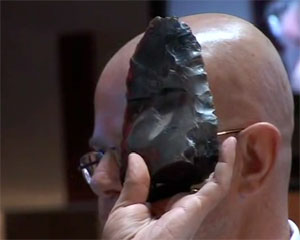
In this Edge Video, archeologist Tim Taylor conducts an experiment about making sense of things.

"There are 43 stones passing amongst you. It’s called the Tradescant's Ark Experiment and I’ve named it in honor of John Tradescant and John Tradescant, Sr. and Jr., father and son, who were collectors of things in the 17th century. They were the exhibitors of the world's first pay-to-view museum and they had a cabinet of curiosities set up in Lambeth, on the Thames, which much later was sold to Elias Ashmole and became the germ of the Ashmolean Museum. Not much of it survives, there are little parts of it in the Ashmolen Museum. What is more important is the intellectual move they made in the catalog, which John Tradescant the younger created and in which he distinguished between 2 types of things, naturalls and artificialls. He divided all the things he collected into those he thought were natural and those that were modified by human hand—what archaelogists today call artifacts."

TIMOTHY TAYLOR teaches in the Department of Archaeological Sciences, University of Bradford, UK, and conducts research on the later prehistoric societies of southeastern Europe. He has presented BBC archaeology programs and he is the author of The Prehistory of Sex: Four Million Years of Human Sexual Culture, and The Buried Soul.

Timothy Taylor's Edge Bio Page

THE TRADESCANT'S ARK EXPERIMENT

Topic: 

  • CULTURE
http://vimeo.com/105880404

"There are 43 stones passing amongst you. It’s called the Tradescant's Ark Experiment and I’ve named it in honor of John Tradescant and John Tradescant, Sr. and Jr., father and son, who were collectors of things in the 17th century. They were the exhibitors of the world's first pay-to-view museum and they had a cabinet of curiosities set up in Lambeth, on the Thames, which much later was sold to Elias Ashmole and became the germ of the Ashmolean Museum. Not much of it survives, there are little parts of it in the Ashmolen Museum.

WHAT IS YOUR FORMULA? YOUR EQUATION? YOUR ALGORITHM?

FORMULAE FOR THE 21ST CENTURY
Hans Ulrich Obrist
[10.12.07]


AN EDGESERPENTINE GALLERY COLLABORATION


Introduction

I recently paid a visit to the Serpentine Gallery in Kensington Gardens, London to see Swiss curator Hans Ulrich Obrist, a long-time friend with whom I have a mutual connection: we both worked closely with the late James Lee Byars, the conceptual artist who, in 1971, implemented "The World Question Center" as a work of conceptual art.

The walls of Obrist's office were covered with single pages of size A4 paper on which artists, writers, scientists had responded to his question: "What Is Your Formula?" Among the pieces were formulas by quantum physicist David Deutsch, artist and musician Brian Eno, architect Rem Koolhaas, and fractal mathematician Benoit Mandelbrot.

Within minutes we had hatched an Edge-Serpentine collaboration for a "World Question Center" project, to debut on Edge during the annual Serpentine Gallery Experiment Marathon, the weekend of October 13-14. The plan was to further the reach of Obrist's question by asking for responses from the science-mindedEdge community, thus complementing the rich array of formulas already assembled by the Serpentine from distinguished artists such as Marina Abramovic, Matthew Barney, Louise Bourgeois, Gilbert & George, and Rosemarie Trockel.

Edge Live in London

The Serpentine Gallery Experiment Marathon
10:00 am to 1:30 pm, Sunday 14 October

In addition to the online publication of "Formulae for the 21st Century," Edgewas invited to program four hours of the twenty-four hour Serpentine Gallery Experiment Marathon. The event, which took place October 14th, was held in The Serpentine Gallery Pavilion 2007, commissioned by Serpentine Director Julia Peyton-Jones and designed by Olafur Eliasson and Kjetil Thorson.

Serpentine Gallery Pavilion 2007
© 2007 Olafur Eliasson and Kjetil Thorsen

The session session featured live presentations of "table-top" experiments from zoologist Seirian Sumner (A Cooperative Foraging Experiment — Lessons From Ants), archeologist Timothy Taylor (The Tradescant's Art Experiment), physiologist Simon Baron-Cohen (Do Women Have Better Empathy Than Men), biologist Amrand Leroi (The Songs of Songs), geneticist Steve Jones (Some Like It Hot), physicist Neil Turok (What Banged? and The Morning Line), biologist Lewis Wolpert (How Our Limbs Are Patterned Like The French Flag), and playwright Marcy Kahan in conversation with psychologist Steven Pinker.

—JB

EINSTEIN: AN EDGE SYMPOSIUM

Brian Greene, Paul J. Steinhardt, Walter Isaacson
[9.15.07]

BRIAN GREENE: Naturally, scientists quite generally and string theorists in particular often describe their work without giving all of the associated qualifications all of the time. I, for example,have spoken of string theory as a possible final theory, as the possible theory that would unite all forces and all matter in one consistent framework—and I generally try to say—but perhaps not always—that this is not yet a proven theory; this is our hope for what it will achieve. We aren’t certain that this is where it is going to lead. We just need to explore and see where we land.

PAUL STEINHARDT: What angers people, I think, is the notion that the ultimate theory of physics might allow a googol possibilities. That is, even though everywhere we look in the universe has the same laws as far as we can see and seems remarkably smooth and uniform—more uniform than we needed for human existence—somehow we are supposed to believe that the greater universe that we can't ever see is completely different. I think many people wonder whether a theory like that is science, or metaphysics?

WALTER ISAACSON: That's exactly it: we were talking about why it is that it arouses such passion and then started directly debating string theory. I'd love to take it right back to Einstein—twice you said something that I find very interesting, which is, we have to find a way to make his two grand pillars of 20th century physics compatible, general relativity and quantum theory. Of course Einstein totally would believe that, because he loved unification, he loved unity. Secondly he and Newton agreed on one big thing, which is that nature loves simplicity. But I've always wondered about the more metaphysical philosophical question: how do we know that God likes simplicity? How do we know he wants these things to be compatible? How do we know that quantum theory and relativity have to be reconcilable?

Introduction

The coincidence last spring of Walter Isaacson's Einstein biography (Einstein: His Life and Universe) hitting the #1 spot on the New York Times bestseller list, coupled with the publication of The Endless Universe: Beyond The Big Bang by Paul Steinhardt, the Albert Einstein Professor of Science at Princeton University (coauthored with Neil Turok), created an interesting opportunity.

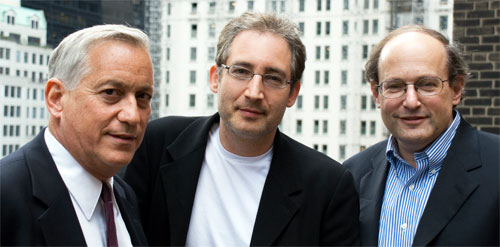
I invited Walter, Paul and Columbia University string theorist, best selling author and TV presenter, Brian Greene, to participate in an Edge symposium on Einstein. Walter, Paul, and Brian, showed up for the session in early June.
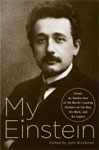
Last year, in My Einstein, a book of essays by twenty-four leading thinkers, I asked each of the contributors to share their thoughts on who is their Einstein. This led me to ask the same questions to the Edge symposium participants.

"That's a hard question and there are many answers I'd give," Brian said, "but I'd say my Einstein surrounded learning—not learning, really hearing—in junior high-school that there is this feature of time whereby if you're moving relative to somebody else time elapses at a different rate compared to the person who's stationary, and thinking to myself, that sounds completely nuts, I really want to understand what this is all about. And little by little finally learning what it actually means, and going on from there to try to push the story a little bit further."

Walter's response: "Einstein is obviously my father," he said, "who as an engineer loved science and instilled that in me, but also has a lot of Einstein's moral nature to him, and political morality to him. I remember every day growing up, his asking me questions and pushing me in a certain way. One of the things I've learned as a biographer, and the first thing you learn, is that as you write about your subject, it's all about Dad—for Ben Franklin it's all living up to his father in a certain way; even to Einstein, a bit— his father's an engineer. And then the second thing you learn is, even for the biographer, it's all about Dad, and that's why I wanted to write about Einstein—I shouldn't say my father's an Einstein, he's just an engineer in New Orleans, but that was his aspirational secular saint, and so I wrote the book and dedicated it to my father."

Paul had a similar response. "One of my earliest memories of childhood," he recounted, "was sitting on my father's knee and his telling me stories about scientists and discovery. He wasn't a scientist, he was a lawyer, but for some reason he used to tell me stories about scientists and different discoveries they made—I remember stories about Madame Curie and Einstein and others."

"From that very initial instance, what I wanted to do was be in a field where you got to make discoveries. The thing that always impressed me the more I learned about Einstein was his uncanny ability to take the wealth of phenomena that people were studying at the time, and pick out not only which were the important questions, but which were the important questions that were answerable. There are always lots of questions you'd like to answer, but knowing whether or not you have the technology, the mathematical technology and the right ideas to attack them at the time—that's a real talent. Einstein had the incredible talent to do that over and over and over again, ahead of any of his contemporaries. So, for me he's the ultimate discoverer. That is my Einstein."

Read on.

—JB

BRIAN GREENE is a professor of physics and of mathematics at Columbia University, is the author of The Elegant Universe: Superstrings, Hidden Dimensions, and the Quest for an Ultimate Theory and The Fabric of the Cosmos: Space, Time, and the Texture of Reality. He is also the presenter of the three-part Nova program, The Elegant Universe, available on DVD.

WALTER ISAACSON, the President and CEO of the Aspen Institute, has been the Chairman and CEO of CNN and the Managing Editor of Time magazine. A noted biographer, his books include Benjamin Franklin: An American Life; and Einstein: His Life and Universe.

PAUL STEINHARDT, a physicist, is the Albert Einstein Professor in Science and on the faculty of both the Departments of Physics and Astrophysical Sciences at Princeton University. He is the coauthor (with Neil Turok) of The Endless Universe: Beyond The Big Bang.

Brian Greene's Edge Bio Page
Walter Isaacson's Edge Bio Page
Paul Steinhardt's Edge Bio Page


[11:21 minutes]

Pages

Subscribe to RSS - CULTURE